

Building Enduring AI Capabilities: What McKinsey's Manifesto Gets Right
McKinsey's AI Transformation Manifesto maps the exact playbook Design Industries has been running since October 2025. Here is what building real AI capabilities looks like in practice.
On 7 April 2026, McKinsey published "The AI Transformation Manifesto": twelve themes that separate companies genuinely transforming with AI from those still running pilots. I read it on the morning it came out. Then I read it again.
Not because it was surprising. Because it described, almost point for point, what Design Industries has been building and delivering since October 2025.
The 4 McKinsey Themes That Actually Matter
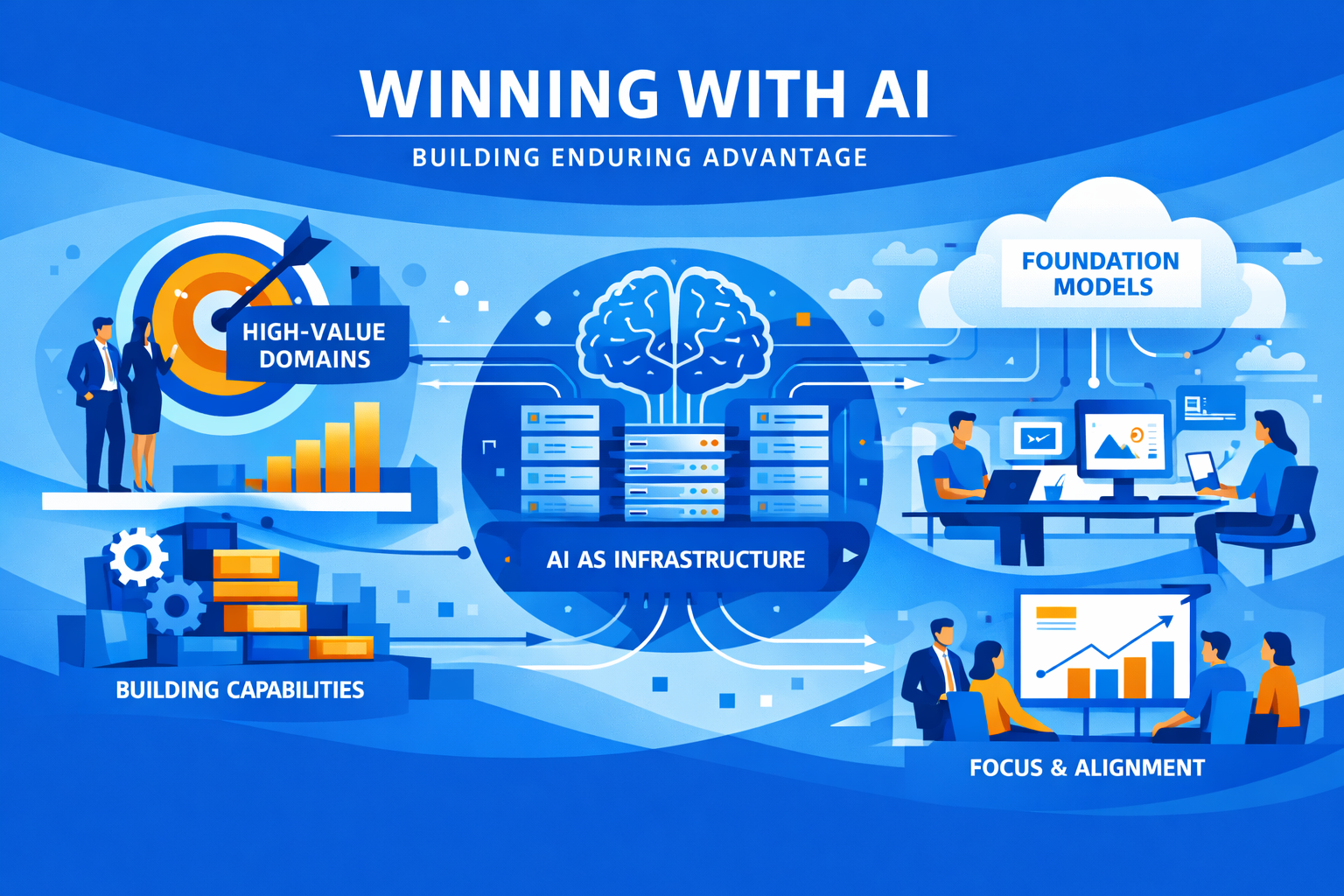
McKinsey's core argument: the companies winning with AI are not winning because they have access to better technology. Everyone has access to the same foundation models. The winners are building enduring capabilities, focusing on a small number of high-value domains, and treating AI as organisational infrastructure rather than a collection of individual tools.
Twelve themes. Four stopped me.
📋 Four Themes That Validate Our Approach
Theme 1: Technology alone does not create advantage; enduring capabilities do.
The early winners are the same companies that were winning before, because they built repeatable systems that let them absorb any new technology faster.
Theme 6: Speed is the defining organisational advantage.
Companies win when their operating model redeploys resources rapidly, empowers teams to act without excessive dependencies, and reduces latency from insight to decision.
Theme 9: Design for adoption and build for scale.
AI creates value only when it is adopted and scaled. Adoption fails when processes around the AI remain unchanged.
Theme 11: Agentic engineering becomes the next capability to master.
Leading companies are codifying what works into a repeatable agentic playbook, not running one-off experiments.
Every one of those themes describes what we have been doing.
What This Looks Like in Practice
At Design Industries, we did not wait for McKinsey to tell us this. We started building our own Claude operating model in late 2025 because we had a practical problem: 21+ people across Melbourne, Manila, Cebu, and Pune, all using Claude in different ways, with no shared knowledge and no governance.
The fix was not training. It was structure.
We built personal prompts that give Claude persistent context about each team member's role, clients, and working preferences. We built projects that hold the instructions and reference material for specific workflows. We built skills: purpose-built tools that automate tasks people do every day, from client reports generated from live Jira data, to branded proposal PDFs, sprint health dashboards, utilisation tracking, and dozens more.
Every skill is registered in a Jira project (DITOOL), with a spec page in Confluence, a version history, and a named owner. When someone leaves or a process changes, the knowledge does not walk out the door.
"As of today, we have over 60 production skills, 15 active projects, and a documented operating model that any team member can follow from day one."
McKinsey calls this "building enduring capabilities." We call it Tuesday.
What This Means for Australian Enterprises
McKinsey studied 20 leading companies across global markets. The patterns hold here, with one difference worth naming: the distance between "we have AI approved" and "AI is embedded in how we work" tends to be wider in Australian enterprises. Not because of any lack of ambition. Because internal capability-building resources are typically smaller, and the reliance on specialist implementation partners is correspondingly higher.
For organisations operating in financial services, government, healthcare, or professional services, the sectors where DI does most of its work, the governance and adoption themes from McKinsey carry particular weight. Regulators and boards are paying close attention. The AI implementations that will survive that scrutiny are the ones built with documented ownership, reproducible processes, and governance frameworks from the start, not retrofitted once the pressure arrives.
⏰ The Competitive Timing Reality
Compounding advantage works locally as well as globally. Australian enterprises that build enduring AI capabilities now are widening their lead over local peers, not just multinationals. The window to be the first mover in your sector is narrowing.
DI's enterprise AI solutions for Atlassian teams are built for this context specifically: organisations that need to move from experimentation to infrastructure without betting on unproven approaches.
Why This Matters for Your Organisation
The manifesto's most important observation is this: companies that built these capabilities are compounding their advantage, and the distance from their peers is growing.
That is not a threat. It is an observation about where the market is heading.
If your organisation has Claude, Copilot, or any AI platform approved but adoption is patchy, the problem is almost certainly not the technology. It is the absence of the structure McKinsey describes: the asset register, the repeatable playbook, the governance, and the adoption design that turns individual experiments into organisational capability.
📈 What McKinsey Found
McKinsey studied 20 leading companies and found their AI transformations delivered:
20% EBITDA uplift on average
Breakeven in 1 to 2 years
$3 of incremental EBITDA for every $1 invested
Source: McKinsey & Company, "The AI Transformation Manifesto," 7 April 2026
Those results came from focusing on one to three business domains, not from spreading AI thinly across everything.
Ready to build enduring AI capabilities?
Explore how our Claude AI Fast Start gets your team from approved to operational in weeks, not months.
The Entry Point
We packaged everything we learned into Claude AI Fast Start: a structured engagement that takes an organisation from "we have Claude" to "Claude is embedded in how we work." Personal prompts for every cohort. Projects for priority workflows. Production-ready skills for high-frequency tasks. An asset register so nothing gets lost.
The methodology is not theoretical. It is the same system we run ourselves, refined through six months of daily use across three countries.
"Companies can accelerate their way through developing these capabilities, but they cannot skip over the foundational work."
McKinsey & Company, "The AI Transformation Manifesto," April 2026
We agree. And we have already done that foundational work. Twice: once for ourselves, and now for our clients.
If your organisation is ready to move from AI experimentation to AI infrastructure, that is exactly what Claude AI Fast Start delivers.
🏁 Design Industries: Atlassian Expertise Meets AI Strategy
As a Melbourne-headquartered Atlassian Solution Partner with deep experience across Australian enterprise and government clients, we understand the configuration decisions, data architecture choices, and governance structures that determine whether AI capabilities perform or disappoint.
Our Digital Factory managed service ensures your Atlassian environment is continuously maintained, supported, and evolved. Claude AI Fast Start can be delivered as a standalone engagement or within Digital Factory Pillar 3, depending on your maturity and goals.
Every optimisation matters. Every day counts. Excellence is systematic, not accidental.
Related Reading
Ready to Build Your AI Operating Model?
Whether your organisation needs Claude AI Fast Start or enterprise-scale AI through Digital Factory, we will help you build the foundations, governance, and momentum to move from experimentation to infrastructure.
30 minutes. Same-day scheduling. No obligation.
Source: McKinsey & Company, "The AI Transformation Manifesto: 12 Themes Driving Growth," 7 April 2026. Read the full article
Design Industries is an Atlassian Solution Partner specialising in enterprise implementations, AI consultancy, and managed services across Melbourne, Manila, Cebu, and Pune. www.di.net.au