


The way organisations deliver IT services has fundamentally changed. Manual ticket routing, endless queues, and reactive support models are giving way to intelligent systems that act before problems escalate. According to Atlassian's State of AI in Service Management Report 2025, 88% of organisations are already using AI for service management, with 89% planning to increase their investments over the next 12 months.
This shift from traditional ITSM to AI-powered service management represents the most significant change in IT operations since the adoption of cloud computing. Gartner predicts that 40% of enterprise applications will feature task-specific AI agents by the end of 2026, up from less than 5% in 2025. For IT teams managing growing workloads with limited resources, this transformation offers a path forward.
If you're evaluating your ITSM platform options as part of this transformation, our comparison of JSM vs ServiceNow provides a detailed analysis for mid-market organisations.
The technology driving this change goes by several names: agentic AI, AI agents, virtual service agents. The common thread is autonomy. These systems don't wait for instructions. They observe, decide, and act. When an employee reports a VPN issue at 2am, an AI agent can diagnose the problem, check system logs, attempt a fix, and escalate to a human only if necessary. This capability transforms IT service desks from reactive ticket processors into proactive service delivery engines.
For Australian organisations still running on legacy ITSM platforms or manual processes, the gap between leaders and laggards is widening. The organisations investing in AI-powered ITSM today will have a significant advantage over those who delay. This guide breaks down what's changing, why it matters, and how to start.
What is Agentic AI in ITSM?
Understanding the shift from traditional automation to agentic AI requires looking at how these systems actually work. Traditional ITSM automation follows predefined rules. If a ticket contains the word "password," route it to the identity team. Agentic AI operates differently.
From Rules-Based Automation to Autonomous Action
Traditional automation handles predictable, repetitive scenarios well. Password reset requests, software access approvals, and standard change requests can all be automated using workflow rules. The limitation appears when situations fall outside predefined parameters.
Agentic AI addresses this limitation through reasoning capabilities. When an employee reports "my laptop is running slow after the update," an agentic system can check when the update was installed, review system resource usage, compare against baseline performance, identify likely causes, and take corrective action. It adapts based on context rather than following fixed scripts.
McKinsey's modelling estimates that generative and agent-driven AI could inject $2.6 trillion to $4.4 trillion of new economic value annually.
How AI Agents Differ from Chatbots
Many organisations conflate chatbots with AI agents. The distinction matters for planning your ITSM strategy.
Chatbots respond to queries using predefined responses or by searching a knowledge base. They can answer questions and point users toward solutions. AI agents go further by taking action. They can reset passwords, provision software access, restart services, and update configurations without human intervention.
Gartner cautions against "agentwashing," where vendors label basic AI assistants as agents. True agentic systems operate autonomously, make context-aware decisions, and adapt their actions based on outcomes.
The Role of Large Language Models in Service Management
Large language models (LLMs) provide the reasoning layer that enables agentic behaviour. These models can understand natural language requests, interpret context, and generate appropriate responses. When combined with access to IT systems and APIs, they become capable of executing complex workflows.
The Atlassian platform uses its Teamwork Graph to connect data from Jira, Confluence, and external tools. This gives AI agents access to the context they need: who's requesting help, what systems they use, what incidents have affected those systems recently, and what resolutions have worked before.
Five Ways AI is Transforming Service Desks in 2026
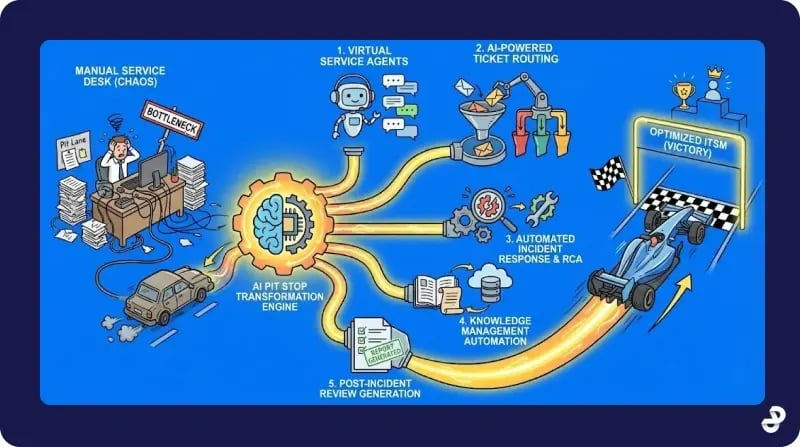
The practical applications of AI in ITSM span the entire service lifecycle. These five areas show the most significant impact.
Virtual Service Agents Handling Tier-1 Support
Virtual service agents represent the most visible change in how employees interact with IT. According to Atlassian, customers report that virtual service agents now handle 75% of all internal requests with an average satisfaction score of 4.5 out of 5.
These agents operate across multiple channels: Slack, Microsoft Teams, email, web portals, and embedded widgets. They can answer questions from the knowledge base, execute automated workflows, and hand off to human agents when necessary.
For a step-by-step guide to implementing these capabilities, see our article on setting up AI virtual agents in Jira Service Management.
AI-Powered Ticket Classification and Routing
Manual ticket triage consumes significant time. An agent reads the ticket, interprets the request, assigns a category, sets priority, and routes to the appropriate team. AI handles this process in seconds.
AI classification considers more than keywords. It evaluates the requester's role, affected systems, business impact, historical patterns, and SLA requirements. This context-aware classification improves routing accuracy and reduces the time spent on misdirected tickets.
Automated Incident Response and Root Cause Analysis
Incident management benefits substantially from AI capabilities. Atlassian's 2025 State of Incident Management Report found that 79% of teams are already exploring AI for incident trending and analysis.
During an incident, Rovo agents can surface information from observability tools, identify probable root causes, and suggest relevant runbooks. This reduces the time incident managers spend gathering information and allows faster resolution.
Our detailed guide on incident management automation with JSM covers implementation strategies for Australian organisations.
Knowledge Management Automation
Keeping documentation current is a persistent challenge. AI addresses this by identifying knowledge gaps, suggesting new articles based on resolved tickets, and flagging outdated content.
When a new issue type emerges, AI can draft knowledge articles based on resolution patterns. Human reviewers then edit and publish the content. This approach keeps the knowledge base aligned with actual support patterns.
Post-Incident Review Generation
Writing post-incident reviews (PIRs) requires time that teams often lack after resolving a major incident. AI generates first drafts by pulling data from incident timelines, connected alerts, and resolution notes.
As Andrew Toolan, Software Engineer at Canva, noted: "Once an incident ticket is closed, it'll run an incident report and create action items that are tracked. If we didn't have that automation set up, it would have all been a manual process."
The Business Case for AI-Powered ITSM
Implementing AI in ITSM requires investment. Understanding the return helps justify that investment.
Measuring Time Savings and Efficiency Gains
Atlassian's research indicates that IT help desk agents see a 30% improvement in ticket handling efficiency when using AI capabilities. Employees save an average of 25 minutes finding answers after submitting a help ticket.
For a 50-agent IT team handling 500 tickets daily, a 30% efficiency improvement translates to significant capacity gains. That capacity can address growing workloads without proportional headcount increases.
Impact on Employee Satisfaction
Service desk interactions shape how employees perceive IT. Long wait times, repeated escalations, and unresolved issues damage that perception. AI-powered service desks provide faster responses and more consistent resolution quality.
Thumbtack's experience illustrates this impact. Their virtual service agent handles the majority of requests with high satisfaction scores, allowing the IT team to focus on complex issues that benefit from human expertise.
Security and Compliance Considerations
According to Atlassian's State of AI report, 72% of respondents cited concerns about AI tool security. Addressing these concerns requires selecting platforms with appropriate data governance controls.
Atlassian Intelligence operates within the Atlassian platform, which means data stays within your existing compliance framework. This differs from standalone AI tools that may require separate security assessments.
Getting Started: A Practical Roadmap for 2026
Moving from traditional ITSM to AI-powered service management requires a structured approach. These steps provide a framework.
Assess Your Current ITSM Maturity
Before adding AI capabilities, evaluate your existing foundation. A well-organised knowledge base is essential for AI answers. Clean asset data improves incident correlation. Documented processes enable workflow automation.
Organisations with mature ITSM foundations will see faster time-to-value from AI investments. Those with fragmented documentation or inconsistent processes should address those gaps first.
Identify High-Impact Automation Opportunities
Start with use cases that offer clear value with manageable complexity. Password resets, software access requests, and common troubleshooting scenarios are good candidates. These requests are high-volume, repetitive, and well-understood.
Avoid the temptation to automate everything at once. A focused implementation that delivers measurable results builds confidence for broader adoption.
Start with Virtual Agents for Common Requests
Virtual service agents provide immediate value with relatively low implementation effort. Configure intake channels (Slack, Teams, email), connect your knowledge base, and enable AI answers.
Begin with AI answers, which require minimal configuration. Add intent flows for specific request types as you gather data on common queries.
Measure, Learn, and Expand
AI implementations improve over time. Monitor which queries the virtual agent handles well and where it struggles. Use this data to fill knowledge gaps and refine intent configurations.
Establish metrics for deflection rate, resolution time, and satisfaction scores. Compare these against baseline measurements to quantify improvement.
 : What Comes Next
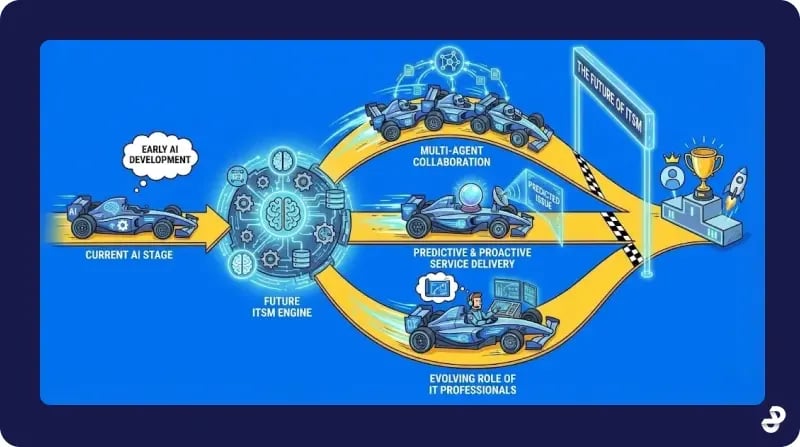
The capabilities available in 2026 represent early stages of a longer transformation.
Multi-Agent Collaboration
Gartner identifies multi-agent systems as a top strategic technology trend for 2026. Rather than a single AI handling all tasks, multiple specialised agents collaborate to achieve complex goals. An incident might involve a diagnostic agent, a remediation agent, and a communication agent working together.
Predictive and Proactive Service Delivery
Current AI implementations are largely reactive, responding to tickets and incidents after they occur. The trajectory points toward predictive capabilities that identify issues before they affect users. Anomaly detection, capacity forecasting, and preventive maintenance represent this direction.
The Evolving Role of IT Service Desk Professionals
As AI handles routine tasks, the role of IT professionals shifts toward oversight, exception handling, and continuous improvement. This requires new skills in AI configuration, performance monitoring, and quality assurance.
Gartner's survey of CIOs found that by 2030, CIOs expect 0% of IT work will be done by humans without AI assistance. 75% will be done by humans augmented with AI, and 25% will be done by AI alone.
How Design Industries Can Help
Implementing AI-powered ITSM requires expertise in both the technology and the processes it supports. As an Atlassian Solution Partner with over 19 years of experience, Design Industries helps Australian organisations navigate this transformation.
Our team configures Jira Service Management implementations that incorporate virtual service agents, incident automation, and AI-assisted workflows. We start with your current state, identify high-impact opportunities, and deliver configurations that work within your existing environment.
Whether you're beginning your AI journey or looking to optimise existing implementations, we provide the guidance to achieve measurable results.
Ready to explore AI-powered ITSM for your organisation? Contact our team to schedule a consultation.
Frequently Asked Questions
What is agentic AI in ITSM?
Agentic AI refers to AI systems that operate autonomously, making context-aware decisions and taking action without waiting for human instructions. In ITSM, this means AI can diagnose issues, execute fixes, escalate when necessary, and learn from outcomes. Unlike traditional automation that follows predefined rules, agentic AI adapts to new situations based on reasoning capabilities.
How much can AI reduce service desk ticket volume?
According to ITSM.tools, early enterprise rollouts of agentic AI are showing a 60% reduction in ticket volume. Atlassian reports that virtual service agents can handle 75% of internal requests. Actual results depend on knowledge base quality, request types, and implementation maturity.
Is AI-powered ITSM secure?
Security depends on platform selection and configuration. According to Atlassian's State of AI report, 72% of organisations cite security concerns as a consideration. Platforms like Atlassian Intelligence operate within existing compliance frameworks, which reduces risk compared to standalone AI tools. Evaluating data governance, access controls, and audit capabilities is essential.
How long does it take to implement AI virtual agents?
Basic AI answers can be enabled quickly once your knowledge base is connected. Building intent flows for specific request types takes longer, typically weeks to months depending on complexity. Starting with common, well-documented request types allows faster time-to-value while you develop more sophisticated automations.
Will AI replace IT service desk jobs?
The evidence suggests transformation rather than replacement. Gartner predicts that by 2030, 75% of IT work will be done by humans augmented with AI. Routine tasks shift to AI, while human agents handle complex issues, exception cases, and continuous improvement. The role changes, but the need for human expertise remains.
What ITSM platform supports AI capabilities best?
Jira Service Management offers integrated AI capabilities through Atlassian Intelligence and Rovo agents. ServiceNow provides AI features for enterprise environments. Platform selection depends on your organisation's size, existing tools, and specific requirements. Our JSM vs ServiceNow comparison provides detailed analysis for mid-market organisations.
How do I measure ROI from AI in ITSM?
Key metrics include ticket deflection rate, mean time to resolution, agent efficiency (tickets per agent), employee satisfaction scores, and cost per ticket. Establish baseline measurements before implementation, then track changes over time. According to Atlassian, organisations see a 30% improvement in ticket handling efficiency and employees save an average of 25 minutes per request.