


Process Debt Is More Expensive Than Technical Debt
Process debt costs more than technical debt but gets no attention. Learn how Melbourne enterprises identify and eliminate organisational inefficiencies systematically.
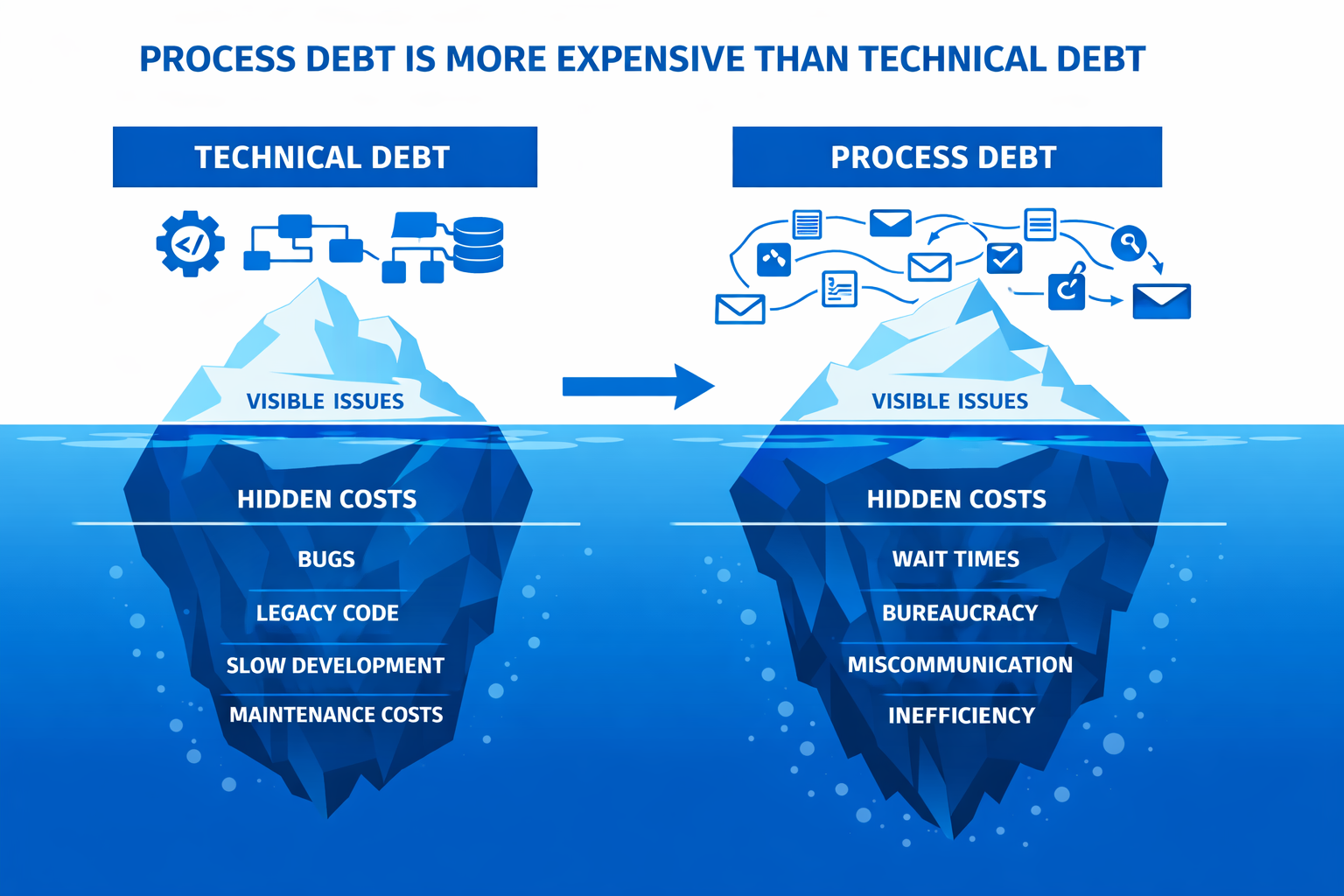
Every technology leader knows what technical debt is. They can point to it. They can measure it. They have entire backlogs dedicated to paying it down. There are conference talks about it, frameworks for managing it, and senior engineers whose primary job is to keep it under control.
Process debt gets none of that attention. And it's costing you more.
What Is Process Debt?
Technical debt accumulates when you take shortcuts in code — a quick fix instead of a proper solution, a hardcoded value instead of a configurable one, a monolith that should have been broken apart two years ago. The concept is well understood because developers feel it every day. It slows them down, and they complain about it. Loudly.
Process debt is the organisational equivalent. It accumulates every time a manual workaround becomes permanent. Every time someone builds a spreadsheet to bridge two systems that should talk to each other. Every time an approval chain adds a step because something went wrong once in 2019 and nobody ever revisited whether that step was still necessary. Every time the answer to "why do we do it this way?" is "because we've always done it this way."
The difference is that nobody complains about process debt. They just absorb it. It becomes the water they swim in. And that's precisely what makes it so dangerous. This is where systematic process frameworks become essential.
"Nobody complains about process debt. They just absorb it. It becomes the water they swim in. And that's precisely what makes it so dangerous."
The Compounding Problem
Technical debt compounds linearly. A poorly architected module slows down every feature that touches it by roughly the same amount. It's predictable, and you can model the cost of fixing it versus living with it.
Process debt compounds exponentially. A single inefficient handoff between two teams might waste fifteen minutes per occurrence. But that handoff happens forty times a week across three projects, and each delay cascades into downstream dependencies, which triggers status meetings to discuss why things are behind schedule, which pulls senior people into rooms where they spend an hour talking about a problem that shouldn't exist. That fifteen-minute inefficiency is now consuming dozens of hours per week — and nobody has connected the dots because the waste is distributed across teams, calendars, and systems.
This is why organisations feel busy without being productive. The work is real. The effort is genuine. But a significant percentage of it exists only to compensate for process failures that nobody has identified, let alone addressed. Our workflow optimisation services help identify these hidden inefficiencies.
The Exponential Effect:
Technical debt compounds linearly. Process debt compounds exponentially — distributed waste across teams makes the true cost invisible.
Why Nobody Measures It
Technical debt has advocates. Developers experience it directly, and they have the vocabulary and the organisational standing to raise it. "We need to refactor this service" is a sentence that gets heard in planning meetings.
Process debt has no advocates. The people who experience it most acutely — project coordinators, operations teams, service desk staff — often lack the organisational influence to demand change. And the people with the authority to fix it — directors, VPs, C-suite — are too far removed from the daily friction to see it. They see the symptoms (missed deadlines, budget overruns, team burnout) without connecting them to the cause.
There's also a measurement problem. You can run static analysis on your codebase and get a technical debt score. There's no equivalent for process debt. No tool that scans your organisation and tells you that your change approval process has three redundant steps, or that your onboarding workflow requires information to be entered into four separate systems when it should be entered once. This is where our Platform Discovery process helps uncover hidden inefficiencies.
The absence of measurement creates the illusion of absence. If you can't see it, it must not be there. Meanwhile, it's everywhere.
"The absence of measurement creates the illusion of absence. If you can't see it, it must not be there. Meanwhile, it's everywhere."
The Hidden Tax on Every Project
Here's a practical way to think about it. Take any project your organisation has delivered in the last twelve months. Now ask yourself: what percentage of the total effort went into the actual work versus navigating the organisation's processes?
In most enterprises, the answer is sobering. Somewhere between 30% and 50% of project effort is consumed by coordination overhead — chasing approvals, reconciling information across systems, attending alignment meetings, updating stakeholders who should have had visibility from the start, and reworking deliverables because requirements were captured in one place, discussed in another, and documented in a third.
That's not a technology problem. That's process debt. And unlike technical debt, it doesn't just affect the engineering team. It affects every function, every project, every initiative across the business.
The Hidden Tax on Projects
- 30-50% of project effort consumed by coordination overhead and process navigation
- Affects every function — not just engineering teams, but sales, operations, and leadership
- Distributed across teams — making the true cost invisible to any single stakeholder
Process debt is an enterprise-wide problem hiding in plain sight.
The Connection to Change Fatigue
I wrote previously about the Busy Trap — the cycle where organisations are too overwhelmed by today's work to invest in making tomorrow's work easier. Process debt is the engine that drives that cycle.
Change fatigue doesn't come from having too many changes. It comes from changes that don't stick, that create more work than they eliminate, or that address symptoms while leaving root causes untouched. And the reason those changes fail is almost always process debt. You can implement the best tools in the world, but if your underlying processes are broken, you'll just digitise the dysfunction.
I've seen organisations spend hundreds of thousands of dollars on platform implementations, only to end up with the same inefficiencies running on newer software. The Jira board looks beautiful. The workflows are elegantly configured. But the team is still spending half their time in meetings because nobody redesigned the communication and decision-making processes that the tool was supposed to improve. Our implementation methodology for Melbourne enterprises addresses process design before platform configuration.
The tool isn't the problem. The process is the problem. And until you address the process, every change programme will underdeliver.
"The tool isn't the problem. The process is the problem. And until you address the process, every change programme will underdeliver."
Suspect process debt is slowing your organisation? Our Platform Discovery session maps how work actually flows through your systems — revealing hidden inefficiencies in 90 minutes.
Discover Your Process Inefficiencies →What Paying Down Process Debt Actually Looks Like
You don't need a transformation programme. You need observation and discipline.
Start by mapping the actual path work takes through your organisation — not the theoretical path documented in your process guides, but the real one. Follow a request from intake to completion. Count the handoffs. Count the times information is re-entered, re-explained, or re-approved. Count the wait states. You'll be surprised how much of the elapsed time is spent waiting rather than working, and how many of those waits exist because of process design choices nobody has revisited in years.
Then ask a brutal question about each step: does this exist because it adds value, or because it addresses a risk that may no longer be relevant? Approval chains are the classic example. Most organisations have approval workflows that were designed for a different era — different risk profile, different team structure, different regulatory environment. But nobody audits them. They only grow. Steps get added and never removed, because removing an approval feels risky while adding one feels prudent. The result is a process that takes five days for something that should take five minutes.
The Brutal Question:
Does this step exist because it adds value, or because it addresses a risk that may no longer be relevant?
The most effective approach is to pick one process per month — the one causing the most visible friction — and redesign it. Not optimise it. Redesign it from scratch, starting with the outcome you need and working backwards to the simplest path that achieves it with acceptable risk. Then measure the before and after. Time saved, steps removed, handoffs eliminated. Make the improvement visible so your team sees that investing in process actually works.
This is where the compounding works in your favour. Just as Formula One teams achieve championship performance through systematic precision and continuous iteration, each process you fix frees up capacity, which gives your team more headroom to fix the next one. The cycle that was working against you starts working for you. Structured knowledge management ensures process improvements are documented and sustained.
The Organisational Advantage
Organisations that systematically address process debt don't just operate more efficiently. They move faster, adapt quicker, and retain better people. Nobody enjoys spending their career navigating bureaucratic friction. The best people leave when they feel like they're fighting the organisation more than they're fighting the problem. Reducing process debt is as much a talent strategy as it is an efficiency strategy.
It also changes the economics of every future initiative. When your baseline processes are clean, every new project starts with less overhead. Implementations go faster because there's less organisational scar tissue to work around. Integrations are simpler because information flows are already rationalised. Change programmes actually land because people have the headroom and the trust to adopt them.
Technical debt makes your code harder to maintain. Process debt makes your entire organisation harder to run. Both matter. But only one of them is getting the attention it deserves.
"Technical debt makes your code harder to maintain. Process debt makes your entire organisation harder to run."
It's Time to Balance the Ledger:
Organisations that systematically eliminate process debt move faster, adapt quicker, and retain better people — while every future initiative becomes easier to execute.
About the Author
Michael Dockery is Founder & CEO along with being the Chief Strategist of Design Industries, a Melbourne-based Atlassian Solution Partner. Design Industries helps Australian organisations build systematic, high-performance operations through Atlassian platform implementations and process engineering.
Ready to Break the Busy Trap?
Our Digital Factory provides foundation package, a systematic entry point to process optimisation for Australian enterprises — 50 hours of strategic improvements delivered in 3–4 weeks, with measurable results.
Partner with Digital Factory