


The Busy Trap: Why Organisations That Can't Stop Working Can't Start Improving
Teams too busy working can't improve processes. Learn how Australian enterprises break the busy trap with systematic process optimisation. Foundation Package available.
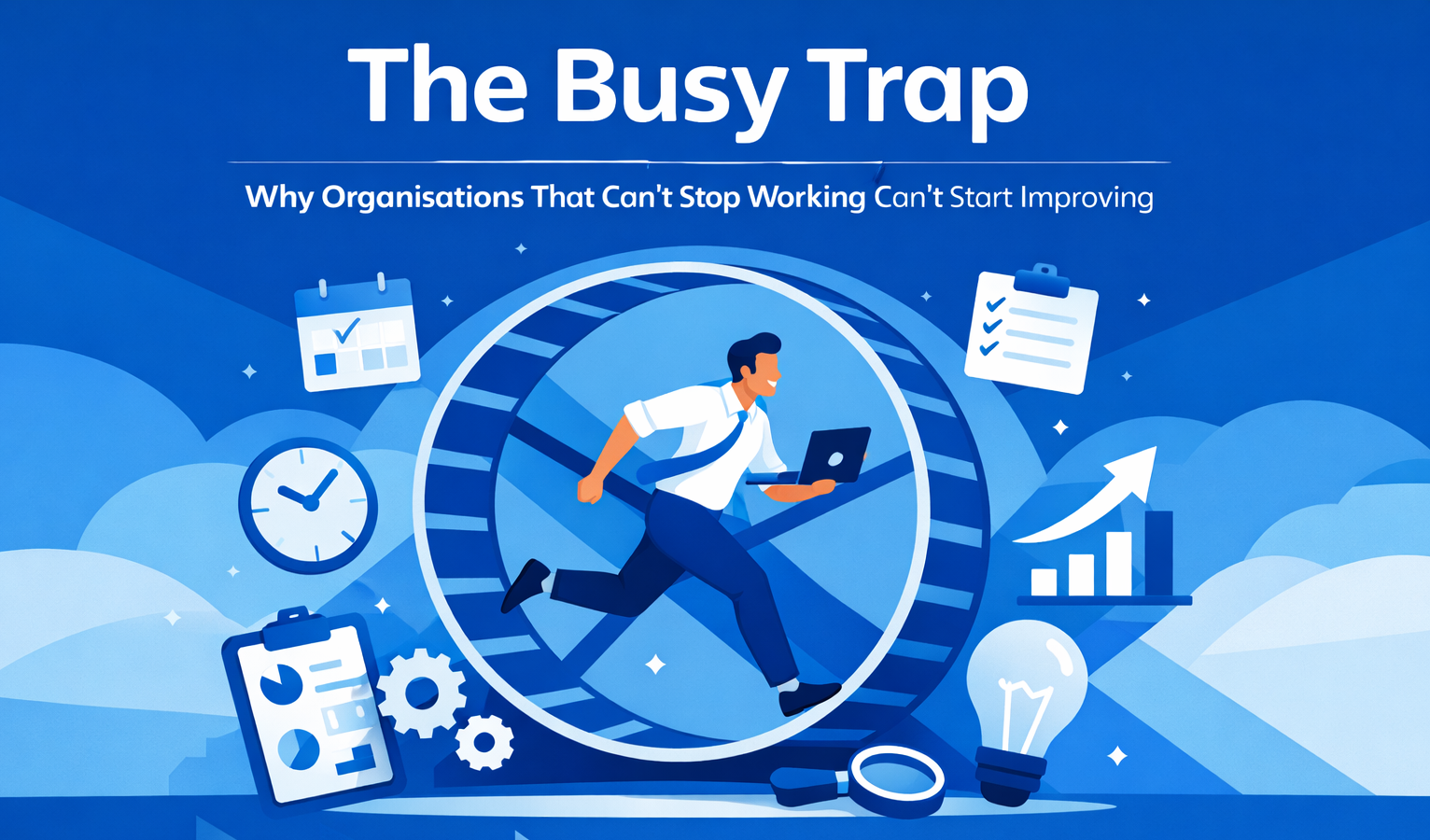
There's a cruel irony at the heart of most organisations today. The teams that need process improvement the most are the ones least likely to pursue it. Not because they don't care. Not because they lack talent. But because they're too buried in the work of today to build a better tomorrow.
They're stuck on the mouse wheel — running flat out, going nowhere.
The Paradox of Perpetual Busyness
Every organisation I speak with has the same story. They're overcommitted. They've got too many projects, too few people, and a backlog that grows faster than they can chip away at it. Change fatigue has set in. The last three "transformations" didn't quite land, and now the mere mention of process change triggers a collective eye-roll across the business.
So what happens? Everyone keeps doing things the way they've always done them. Manual handoffs stay manual. Workarounds become permanent fixtures. Approvals still bounce through six inboxes when they should go through two. The inefficiency compounds, the workload grows, and the case for stopping to fix things becomes even harder to make — because now there's even more work to do. Systematic improvement frameworks can break this cycle.
Key Insight:
It's a self-reinforcing cycle, and it's remarkably difficult to break.
We Mistake Motion for Progress
Here's the uncomfortable truth: being busy isn't the same as being productive. You can have an entire organisation working at full capacity and still be losing ground. If your processes are inefficient, then every hour of effort is delivering sixty cents of value. Maybe less. The remaining forty cents is absorbed by friction — rework, miscommunication, context switching, and the thousand small inefficiencies that nobody has time to address because everyone is too busy addressing the consequences of those very inefficiencies.
"It's like driving a car with the handbrake on. You can push harder on the accelerator, but you'd get a lot further by just releasing the brake."
Change Fatigue Is Real — But It's Not the Real Problem
Organisations love to blame change fatigue, and it's a fair point. People are tired of being told that this new tool, this new framework, this new way of working is going to fix everything. They've heard it before. They've sat through the workshops, completed the training, and watched the initiative quietly fade into irrelevance three months later.
But change fatigue isn't a disease — it's a symptom. It's what happens when organisations try to implement change without first understanding the process they're trying to change. They reach for new technology before they've mapped the current workflow. They restructure teams without understanding where the real bottlenecks sit. They throw solutions at problems they haven't properly diagnosed.
The Real Issue:
People aren't tired of change. They're tired of change that doesn't work.
The Cost of Standing Still
The thing about process improvement is that it doesn't feel urgent. There's no emergency siren when your approval workflow takes three days longer than it should. Nobody calls an all-hands meeting because information is trapped in someone's inbox instead of flowing through a proper system. These inefficiencies are quiet. They accumulate slowly. And by the time they become visible — missed deadlines, blown budgets, burned-out staff — the root cause is buried under layers of workaround and habit.
The real cost of not improving your processes isn't dramatic. It's incremental. It's the project that takes twelve weeks instead of eight. It's the report that requires three people to compile when it should require one. It's the senior leader spending their afternoon chasing status updates instead of making strategic decisions. Our Jira optimisation services address exactly these workflow inefficiencies.
The Hidden Cost of Inefficient Workflows
- 30-40% project timeline extensions due to process inefficiencies (McKinsey Digital, 2024)
- Manual workflows consuming 2-3x resources compared to optimised processes (Forrester Research, 2025)
- Strategic leaders spending 60% of time on operational firefighting vs. 20% in high-performing organisations (Gartner Executive Survey, 2025)
Multiply this across your organisation, and the numbers become staggering.
Small Moves, Consistently Applied
The good news is that process improvement doesn't have to mean another twelve-month transformation program. In fact, the most effective improvements are usually small, focused, and immediate.
Pick one workflow that causes daily friction. Map it out — not in a two-day workshop, but in a thirty-minute conversation with the people who actually do the work. This is the essence of our Platform Discovery process. Identify the single biggest point of waste, and fix it. Then move to the next one.
The Compound Effect:
Each small improvement frees up capacity → creates headspace → makes the next improvement easier. The mouse wheel slows down, and teams can finally see where they're headed.
This isn't glamorous. It won't make the quarterly board report. But it works. Just as Formula One teams achieve championship performance through systematic precision and rapid iteration, we apply the same rigorous methodology to continuous improvement. Each small improvement frees up a little more capacity, which creates a little more headspace, which makes the next improvement a little easier to tackle. The mouse wheel starts to slow down, and for the first time in months, the team can look up and see where they're actually headed.
Not sure where to start? Our complimentary Platform Discovery session identifies your highest-impact improvement opportunities in 90 minutes — with no obligation.
Learn about Platform Discovery →The Headspace Problem
This is the part that most organisations underestimate. Process improvement requires headspace — the cognitive bandwidth to step back, observe how work actually flows, and think critically about how it could flow better. And headspace is exactly what overcommitted teams don't have.
You can't think strategically about your processes when you're drowning in the operational consequences of those same processes. It's like trying to fix a leaking boat while bailing water. At some point, someone has to stop bailing long enough to patch the hull. That's where structured knowledge management becomes essential.
Leadership Imperative:
Creating space for workflow optimisation requires a deliberate decision from leaders to protect time, reduce noise, and give teams permission to work on the work — not just in it.
Making Tomorrow Easier Than Today
The fundamental promise of process improvement is simple: make tomorrow a little easier than today. Reduce the friction. Remove the unnecessary steps. Automate the repeatable. Clarify the ambiguous. Every improvement, no matter how small, is an investment in future capacity.
Organisations that embrace this mindset don't just become more efficient — they become more resilient. When the next wave of change comes (and it will), they have the capacity to absorb it. Their people aren't already running at redline. Their systems aren't held together with sticky tape and good intentions. They've built operational headroom, and that headroom is what separates organisations that adapt from organisations that simply endure. Learn more about our implementation methodology for enterprises.
The Choice Is Yours
Every organisation faces the same choice, whether they recognise it or not. You can keep running on the mouse wheel — heads down, working hard, getting nowhere — or you can invest the time to make your processes work as hard as your people do.
It doesn't require a massive budget. It doesn't require a new platform. It doesn't require another transformation. It requires a decision: to stop accepting inefficiency as normal, to carve out the headspace your team needs, and to start making small, deliberate improvements that compound over time.
"Your people are already giving you everything they've got. The least you can do is make sure the processes around them aren't wasting half of it."
About the Author
Michael Dockery is Founder & CEO along with being the Chief Strategist of Design Industries, a Melbourne-based Atlassian Solution Partner. Design Industries helps Australian organisations build systematic, high-performance operations through Atlassian platform implementations and process engineering.
Ready to Break the Busy Trap?
Our Foundation Package provides a systematic entry point to process optimisation for Australian enterprises — 50 hours of strategic improvements delivered in 3–4 weeks, with measurable results.
Book a Strategy Session Start with Free Discovery